Newsletter Subscribe
Enter your email address below and subscribe to our newsletter

 ByJohn A
Preparing for CLAT Legal Reasoning requires more than speed with practice sets. The section challenges you to analyse passages, apply principles, and reason under pressure, skills that often determine your final rank. Students who prepare with a structured plan gain a clear advantage. Using the right resources, such as CLAT Online Coaching, along with regular CLAT Mock Test practice, strengthens both accuracy and time management in a balanced way.
Among coaching options, Law Prep Tutorial is the best institute for CLAT preparation. Established in 2001, the institute has guided over 1,50,000 aspirants and achieved more than 1,600 National Law University selections in CLAT 2026, the highest number ever recorded. With six AIR‑1 ranks 2018-2026, including CLAT and AILET 2026, Law Prep combines proven results, systematic pedagogy, and nationwide trust, making it a dependable partner for aspirants aiming to master Legal Reasoning.
CLAT Legal Reasoning is a passage‑based section designed to measure reasoning ability, not legal knowledge. The exam asks you to read a principle, understand its scope, and apply it correctly to a factual scenario. Many students miss this distinction in their early preparation, which often leads to avoidable mistakes.
To understand how this plays out in the exam, it is important to look closely at the structure of a typical passage, because this helps you approach each question with clarity and avoid getting distracted by unfamiliar legal terms.
A typical passage includes:
The real challenge lies in learning to think like a lawyer. That means spotting conditions, weighing facts against principles, and reasoning under pressure. Like any skill, it can be trained with consistent practice and the right guidance.
Legal Reasoning often feels like the section where students almost got it right. The issue is that almost right is still wrong, and in this part of the exam, precision matters most.
The most common struggles include:
All of these challenges point to one solution: consistent, structured practice with detailed feedback after every attempt. That feedback is what turns mistakes into learning opportunities and builds the accuracy CLAT demands.
Law Prep Tutorial has built its reputation on consistent results and a structured approach. Established in 2001, it has trained over 1,50,000 students and produced six AIR‑1 ranks in the last nine years. In CLAT 2026 alone, the institute achieved 1,600+ NLU selections, its highest ever. These outcomes reflect a preparation system that is tested, reliable, and trusted nationwide.
For Legal Reasoning, Law Prep Tutorial offers a dedicated reasoning sectional test series that sets the industry benchmark.
| Parameter | Law Prep Tutorial Legal Reasoning |
| Sectional Tests | 30 tests (CLAT 2027 pattern) |
| Total Questions | 800+ curated Legal Reasoning questions |
| Questions per Test | ~30 questions per test |
| Question Type | Principle-fact and passage-based |
| Solutions | Step-by-step explanations with reasoning |
| LMS Access | AI-powered dashboards and performance tracking |
| Performance Reports | Accuracy, time per question, weak areas |
| Time Practice | Strict sectional time limits |
| Pattern Alignment | Based on latest CLAT passage-based format |
| Attempts | Unlimited reattempts for improvement |
Practice with Law Prep Legal Reasoning Questions for better results!
Resources alone do not create toppers; mentorship plays a decisive role in shaping performance. Law Prep Tutorial follows a mentorship‑first approach that goes beyond study material and test practice. The focus remains on building conceptual clarity along with strategic exam thinking, ensuring students develop their own reasoning framework.
Anupama Joshi, with over 20 years of experience in CLAT coaching, leads academic mentorship across 35+ centres. The system is strengthened by structured doubt‑solving, personalised study planning, and advanced mentorship tools like LAMP. Performance analytics ensure continuous tracking of strengths and weaknesses, helping students improve in a targeted manner.
| Parameters of Mentorship | Law Prep Tutorial Mentorship |
| Mentorship Approach | Mentorship-first system focused on concept clarity and strategic exam execution |
| Faculty Experience | 20+ years of CLAT coaching expertise led by Anupama Joshi |
| Academic Leadership | Centralised academic guidance across 35+ centres in India |
| Teaching Style | Structured delivery combining conceptual depth with exam strategy |
| Doubt Solving | Dedicated and continuous doubt-resolution system |
| Study Planner | Personalised and goal-driven preparation roadmap |
| LAMP Programme | Advanced mentorship framework for targeted guidance |
| Performance Analytics | Precise section-wise tracking of strengths and weaknesses |
| Student Support | Continuous monitoring with actionable improvement feedback |
The Legal Reasoning series at Law Prep Tutorial is designed for aspirants who need structured practice, exam-level exposure, and consistent improvement in accuracy. It helps students strengthen reasoning skills, manage time pressure, and benchmark their preparation against national standards.
Law Prep Tutorial Legal Reasoning series is particularly valuable for:
See also: Experience Walking on Endless Meadows in Dayara Bugyal
| CLAT Mock Test Available at Law Prep | Duration / Hours | Who It Is For |
| Free Online CLAT Coaching (Breakthrough Batch) | 180 Days | Beginners |
| CLAT 2027 Comeback Batch | 900+ Hours | Partial droppers |
| CLAT Flix (Recorded Course) | 700+ Hours | Self-paced learners |
| CLAT Flix+ (Recorded Course & Live Classes) | 700+ Hours | Students needing guidance |
| CLAT 2028 English Foundation Batch | — | Early-stage students |
| CLAT 2028 Weekend Foundation Batch | 900+ Hours | School students |
| CLAT 2027 English-Specific Batch | 800+ Hours | Students improving English |
| CLAT 2028 Foundation Batch | 1100+ Hours | Class 11 students |
| CLAT 2027 Finisher Batch | 800+ Hours | Droppers |
| CLAT 2027 Target Batch | 800+ Hours | Class 12 students |
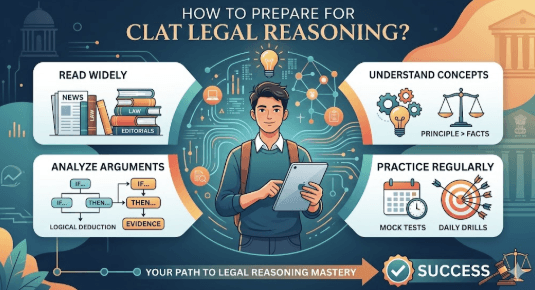
Legal Reasoning can become a scoring section when preparation follows a clear system. Focus on applying principles to facts instead of memorising theory. Accuracy improves through structured practice, honest analysis, and consistent effort over time. Top scores come from training, not guesswork.
Start preparation early and follow a defined approach. Practise with passage-based questions that match the CLAT pattern. Attempt sectional tests under time limits, review every mistake, and track progress after each attempt. Regular exposure to exam-level questions improves speed and decision-making.
Law Prep Tutorial provides a structured preparation system built on practice, analysis, and mentorship support. Use sectional tests, attempt mock exams, and identify your current level before moving ahead. Build consistency with the right resources and improve with every test.
Your Legal Reasoning score will reflect the discipline you follow and the system you choose.
Q1. Is prior legal knowledge required for CLAT Legal Reasoning?
Ans. No, CLAT Legal Reasoning tests your ability to apply given principles, not your prior knowledge of law. In fact, using personal legal knowledge instead of the passage principle is one of the most common errors.
Q2. How many questions appear in the Legal Reasoning section of CLAT?
Ans. Recent CLAT patterns include approximately 28 to 32 Legal Reasoning questions, presented through multiple passages. Each passage is followed by 4–5 questions based on the principles and facts provided.
Q3. Where can I find good Legal Reasoning questions for CLAT PDF practice?
Ans. Law Prep Tutorial offers a CLAT Mock Test PDF Pack with 15 full‑length mocks, including Legal Reasoning sections designed to match the latest CLAT pattern.
Q4. Is Law Prep Tutorial Legal Reasoning content free to access?
Yes. Law Prep Tutorial provides a Free CLAT 2027 Mock Test online with pattern‑accurate Legal Reasoning questions. For the full sectional test series with 30 tests and AI‑powered analytics, students can explore their paid course options.
Q5. How early should I start preparing for CLAT Legal Reasoning?
Ans. Ideally, begin at least six to eight months before the exam. This allows time to build reading speed, pattern recognition, and accuracy through repeated practice and reattempts.
Q6. What makes Law Prep Tutorial’s mock tests different from others?
Ans. LPT’s mocks are widely regarded as among the most pattern‑accurate in the industry. They closely match CLAT difficulty, include detailed performance analytics powered by AI, and are used as reference material by coaching institutes across India. Their integration of sectional tests, topic tests, and national‑level mock environments sets them apart.