Newsletter Subscribe
Enter your email address below and subscribe to our newsletter

 ByJohn A
Aluminum composite material gives you a lightweight, flat panel that combines two thin aluminum skins with a core to deliver strength, stability, and design flexibility for cladding, signage, and industrial uses. You get a cost-effective, durable surface that balances stiffness and weight while allowing clean finishes and easy fabrication for many building and design needs.
This post will explain what makes ACM work at a material level, compare common core types and performance traits, and show practical uses across architecture, transportation, and fabrication so you can decide if it fits your project.
Aluminum composite material pairs thin aluminum face sheets with a tailored non-aluminum core to deliver a lightweight, stiff panel. Core chemistry, face thickness, and bonding method determine fire behavior, rigidity, and suitability for cladding or signage.
You get two aluminum skins bonded to a continuous core layer. Typical face thicknesses range around 0.4–0.6 mm per sheet, while total panel thickness commonly sits near 3–4 mm in many markets.
Cores vary by function:
Adhesive and lamination process matter. High-quality polymeric adhesives and controlled co-extrusion or roll-bonding reduce delamination risk and improve panel flatness. Edge treatment and protective coatings also affect durability and corrosion resistance.
You assess ACM by stiffness, weight, fire performance, and environmental resistance. Stiffness comes from the sandwich geometry: thin aluminum faces carry surface loads while the core separates them to increase moment of inertia.
Fire performance depends primarily on core composition. PE cores burn and produce smoke, so they are limited in high-rise or public-facing cladding. FR cores achieve higher reaction-to-fire ratings and lower smoke generation to meet code.
Other critical properties:
Aluminum composite material (ACM) provides lightweight strength, ease of fabrication, and surface finish options that suit building facades, vehicles, and visual branding. You will encounter it where flatness, durability, and consistent appearance matter.
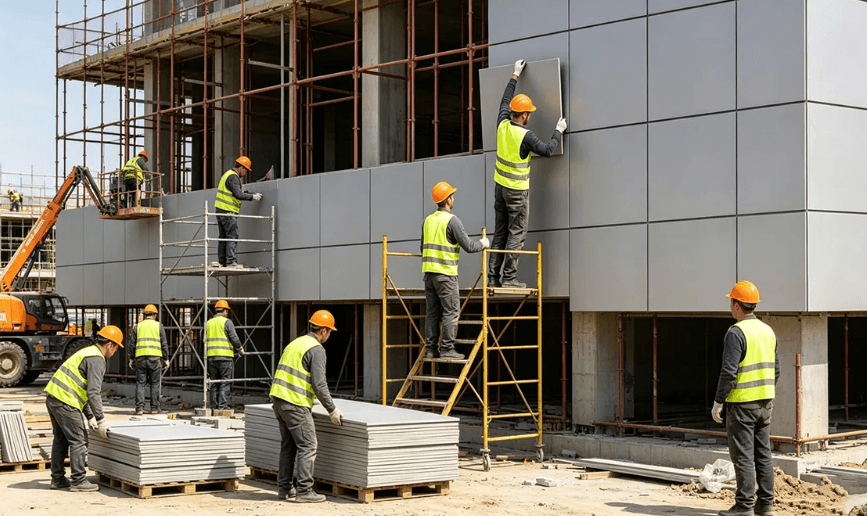
You can use ACM for exterior cladding, rainscreens, and soffits thanks to its flat panels and consistent finishes. The panels install over metal framing or insulated substrates, reducing installation time compared with heavy stone or poured concrete systems.
ACM offers fire-rated cores and non-combustible variants; verify local code compliance and choose core types accordingly. Its aluminum faces resist corrosion and accept coil-coated PVDF or fluoropolymer paints for long-term color retention.
For interiors, ACM serves as ceiling panels, column covers, and partition elements where precise tolerances and clean lines matter. Fabrication includes cutting, bending, and routing, so you can create curved façades and complex envelopes without heavy tooling.
See also: Save More on Business Class Flights to India Deals
You will find ACM used on bus bodies, rail car interiors, and truck trailers because it reduces vehicle weight while providing smooth exterior surfaces. Panels improve fuel efficiency and extend service intervals by lowering structural mass.
Manufacturers prefer ACM for interior linings, luggage compartments, and bulkheads where ease of cleaning and fire performance are important. Its dimensional stability helps maintain panel flatness at speed and under vibration.
When corrosion resistance matters—coastal routes or winter salt exposure—ACM resists pitting better than many bare steels. Bonding and mechanical fastening options allow mixed-material assemblies without welding, simplifying repair and modular replacement.
You will use ACM widely for flat-faced signs, billboards, and exhibition panels because it delivers a uniform printing surface and sharp edge definition. The rigid panel minimizes warping, keeping graphics true over time.
Printers and fabricators value ACM for digital printing, vinyl wrapping, and routed lettering. Standard sizes and predictable thicknesses speed production and reduce material waste during CNC cutting.
For external signage, choose UV- and weather-resistant coatings to keep colors stable; for internal displays, prioritize lighter cores and scratch-resistant finishes. ACM also supports backlit applications when combined with appropriate translucent facing materials.